Packit
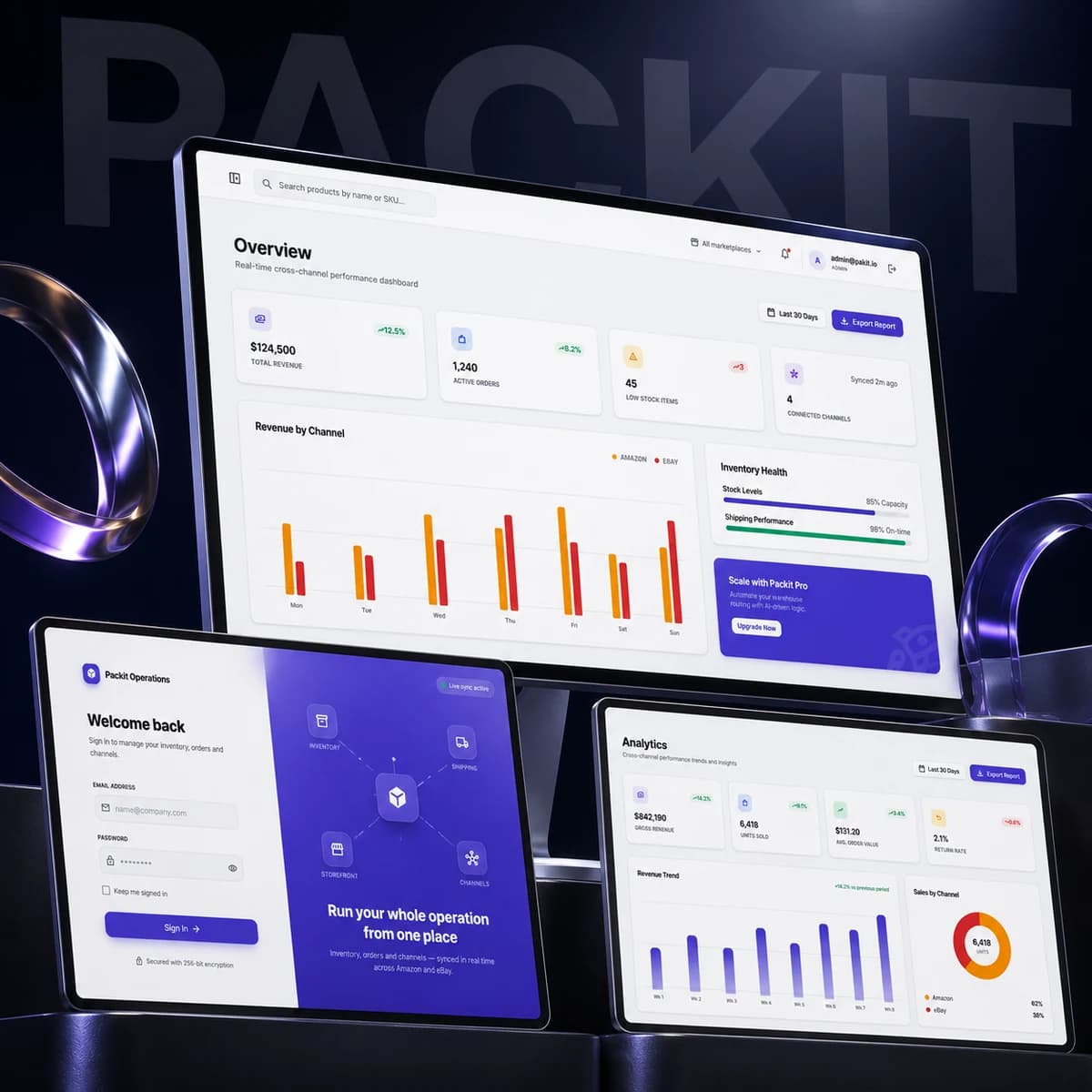
Packit is a multi-channel e-commerce operations platform built by Volanta Labs. It connects a seller's Amazon and eBay accounts through the Amazon SP-API and eBay API, then keeps inventory, orders, shipping and channel data in sync in real time. The build covers the full operator surface: an order dispatch queue that segments unprocessed, unshipped, cancelled and pending orders; a cross-channel analytics dashboard tracking revenue, units sold, average order value and return rate; and inventory health monitoring with low-stock alerts. Background synchronisation runs on Sidekiq so marketplace API calls never block the interface.
- Marketplaces synced
- 2Marketplaces synced
- Order sync interval
- 10 minOrder sync interval
- Inventory sync
- LiveInventory sync
What it does
- Real-time inventory and order sync across Amazon and eBay
- Order dispatch queue with per-status segmentation and bulk actions
- Cross-channel analytics for revenue, units sold and return rate
- Background marketplace sync on Sidekiq, so the UI never blocks
The problem
Multi-channel sellers work out of one seller portal per marketplace. Stock counts live in a spreadsheet that someone updates by hand after checking each portal in turn. The counts are correct at the moment they are typed and drift from then on.
Two things follow from that drift. Orders wait because nobody has looked at the right tab yet, and stock gets sold that is already spoken for, because the spreadsheet does not know about the order placed on the other channel a minute ago.
What we built
Packit is a multi-channel e-commerce operations platform that runs Amazon and eBay from one screen. An overview dashboard opens on total revenue, active orders, low-stock items and the number of connected channels, with a sync indicator showing when the data last refreshed. Revenue is charted by weekday and split Amazon against eBay.
Packit's order dispatch queue is the screen operators live in. Orders arrive from both marketplaces and sort themselves into piles, each pile named for what is blocking it: waiting on payment, SKU not recognised, listing not linked to warehouse stock, unusable address, not enough stock to allocate. Orders that clear every check land in “ready to dispatch” with their stock already reserved. An operator reads the pile name and knows what to fix without opening the order.
How it works
Packit treats a parked order as something to re-check rather than something to repair by hand. Every order walks the same ordered set of gates — paid, SKU known, listing mapped to stock, address usable — and a failed gate parks it with the reason recorded against it. The check is safe to re-run any number of times, so when the cause is fixed the order un-sticks itself on the next sweep. Fixes also target: importing a listing wakes the orders that sold it, and booking in a delivery wakes the orders that were short of that product.
Stock reservation is all-or-nothing inside a database transaction, with each product row locked in id order to avoid deadlocks. If any product on the order is short, nothing is taken and the order parks as unallocated, naming the exact SKU and shortfall. This is what stops the overselling that the spreadsheet allowed.
Marketplace latency is kept off the operator's screen entirely. Sync runs as Sidekiq jobs on a schedule — orders every ten minutes, FBA quantities every fifteen, Buy Box prices every two hours, listings nightly — so a slow marketplace response delays a background job, never a page load. A Redis lock prevents two sweeps overlapping, since a long eBay pass stacking behind another would starve the worker.
The result
Order state is now recorded rather than inferred, every blocked order carries a written reason for being blocked, and resolving a cause clears the affected orders automatically instead of requiring someone to find them.
Built with
- Ruby on Rails
- Sidekiq
- Amazon SP-API
- eBay API
- Tailwind CSS
More from Volanta Labs
- Gomer — The marketing site for an AI employee that works inside Slack and Microsoft Teams, built end to end from positioning to production code.
- NYBVC — A violation-resolution platform for NYC property owners, with lookup, cart-based checkout and SMS/WhatsApp payment links.
- MunshiOnClick — A full cloud ERP for the Pakistani market — accounting, inventory, payroll, POS and CRM in one platform.
- Price Optimizer Pro — An AI repricer for Amazon FBA sellers that raises prices when competitors go out of stock, optimising for profit over Buy Box wins.
Want something like this?
Book a 45-minute call to walk through your project, or email hello@volantalabs.space.
Book a 45-min call